Pool Filter Problems: Causes, Solutions, and How to Restore Filtration
A practical guide to finding out why your pool filter is working poorly, checking the pump, filter, and plumbing, and restoring flow without replacing parts unnecessarily.
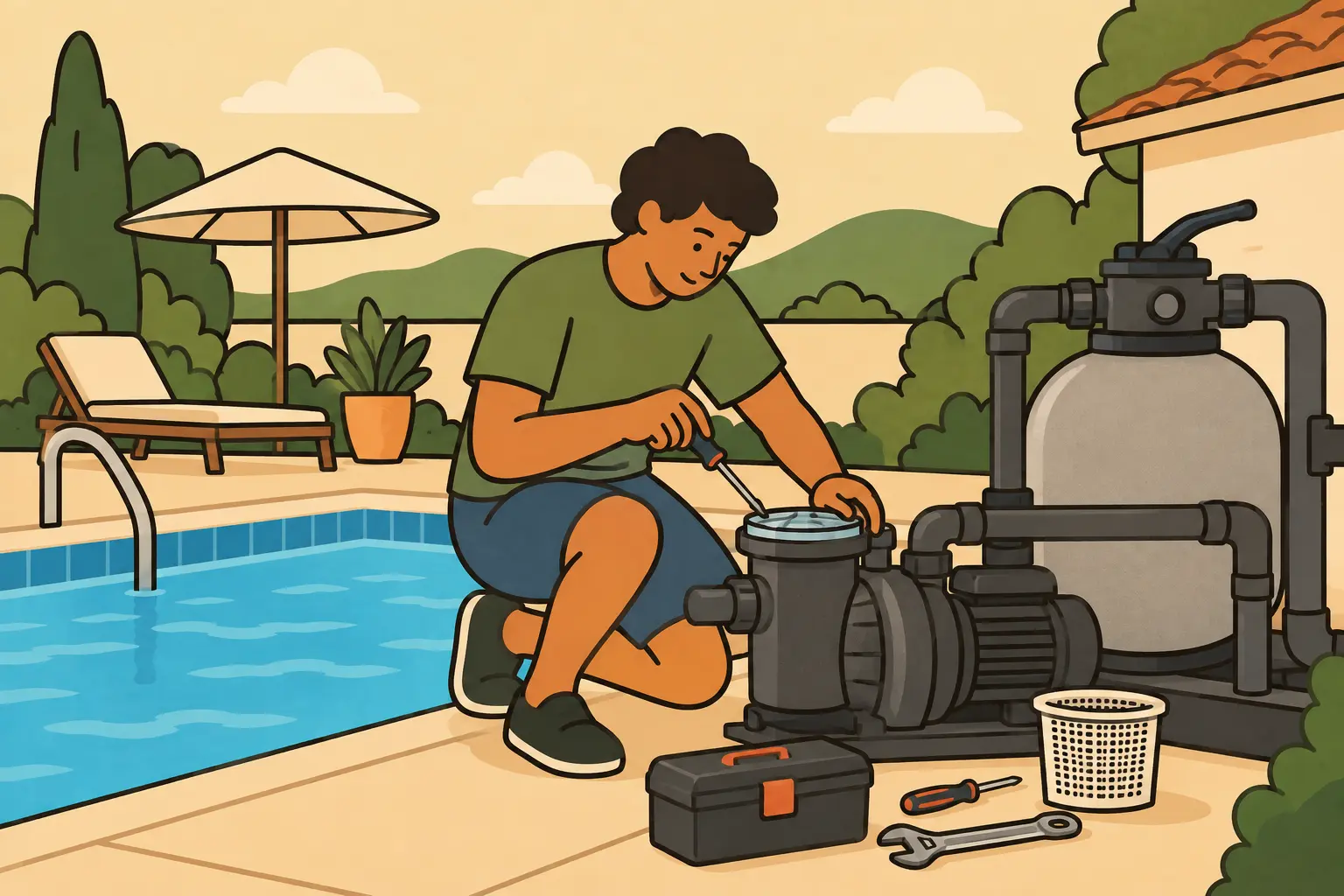
Pool filter problems don’t always mean something is broken. If the pump starts but flow is low, bubbles appear, or the water stays cloudy, the cause could be a full basket, a valve in the wrong position, air entering the suction line, or a clogged filter. This guide helps you check your system in a logical order, starting with the simplest steps, so you can restore filtration without replacing parts unnecessarily.
Pool filter problems: common signs
How to recognize poor filtration
The most obvious sign is cloudy water or debris that remains on the bottom after several hours of filtration. You should also check how strongly water returns through the inlets, listen to the pump, and note the pressure shown on the pressure gauge.
- Water returns with little force or doesn’t come out of the inlets.
- Debris that has been vacuumed up returns to the pool.
- The pump makes rattling or whistling sounds, or a noise like gravel.
- The pressure rises, falls, or fluctuates compared with its usual reading when the filter is clean.
Pump, filter, or plumbing: where to look for the problem
The pump moves the water, the filter traps particles, and the plumbing allows the flow to circulate. If your pool pump isn’t moving water, first check the water level, priming, and possible blockages. If there is flow but debris returns to the pool, check the filter and multiport valve. Continuous bubbles usually point to air entering the suction line.
Why your pool filter isn’t working: basic checks
- Check that the water reaches approximately halfway up the skimmer opening.
- Empty and clean the skimmer and pump pre-filter baskets.
- Make sure the necessary valves are open and the multiport valve is set to Filter.
- Check that the pre-filter is full of water and the pump is properly primed.
- Look for constant bubbles, damp joints, or visible leaks.
Water level, baskets, and valves
A low water level allows the skimmer to draw in air. A stuck weir door, a full basket, or a partially closed valve restricts the water intake and reduces flow. Fix these issues and check the return flow again. Always turn off the pump before operating the multiport valve: changing its position while the pump is running can damage its seal and cause internal leaks.
How to find and remove air from the system
If you see constant bubbles under the clear pre-filter lid or at the inlets, check the lid, its seal, and the joints on the suction side. Clean the seal and lubricate it only with a compatible product. To prime the pump, turn it off, fill the pre-filter with water, close the lid securely, and restart it according to the manufacturer’s instructions.
If the pump repeatedly loses its prime, stop the equipment. Running it without water circulation can damage the mechanical seal and motor.
Pool filter problems and how to fix them
What high, low, or unstable pressure indicates
There is no single correct pressure for every system. The useful reference is the pressure gauge reading when the filter is clean and the system is running normally. Always compare the reading with that value, since pressure depends on the pump, filter, pipes, and valve positions.
| Reading or symptom | Likely cause | First step |
|---|---|---|
| Pressure higher than usual | Clogged filter or blockage in the return line | Clean the filter and check the valves |
| Pressure lower than usual | Insufficient water or flow to the pump | Check the water level, baskets, priming, and suction line |
| Unstable pressure | Air in the system or insufficient water level | Eliminate air leaks and adjust the water level |
Dirty or damaged sand filter
If the pressure rises significantly above its reference reading, backwash and then rinse the filter according to the manufacturer’s instructions. Turn off the pump before each change of position on the multiport valve. If sand comes out of the inlets, debris reappears, or performance barely improves after backwashing, the laterals may be damaged, the multiport valve seal may be worn, or the filter media may be compacted.
Common problems with cartridge filters
Remove the cartridge and clean the pleats with moderately pressurized water, without hard brushes or tools that could tear the fabric. Replace it if it is misshapen, torn, hardened, or needs cleaning more and more often. Before opening the filter, turn off the pump, disconnect the power supply, and release the pressure in the system according to the equipment manual.
The pool filter is running, but the water is still cloudy
Check the water treatment
Filtration removes particles, but it can’t correct an unsuitable pH or inadequate disinfection on its own. If you have cloudy water after filtering, first measure the pH and disinfectant level and adjust them according to the system you use. Then brush the walls and floor, clean the filter, and keep the water circulating for the necessary amount of time. Vacuum settled debris to waste when the condition of the water and the system calls for it.
Work out whether the filtration time is sufficient
Divide the pool volume in cubic meters by the system’s effective flow rate in cubic meters per hour to estimate the time needed for one turnover. For example, 40 m³ with an actual flow rate of 8 m³/h needs around 5 hours per cycle. This is a guide: heat, the number of swimmers, dust, and flow resistance may require more time. Running the filter for many hours won’t make up for a clogged filter, a poorly primed pump, or unbalanced water treatment.
How to prevent filtration problems from happening again
A quick maintenance routine
During the season, regularly check the water level, baskets, return flow, and pressure gauge. Clean the filter when the pressure is clearly outside its normal range or the flow decreases; unnecessary backwashing wastes water. Also check the pre-filter lid, seals, joints, and valves for small leaks or air entering the system before the pump loses its prime.
When to repair or replace the equipment
Replace the sand, glass filter media, or cartridge when it is damaged, compacted, or no longer performs well despite proper cleaning. A stuck pressure gauge or worn seal is usually easy to repair. If the pump has persistent leaks, noisy bearings, overheating, or damage to the casing, compare the cost of repair with that of an efficient, compatible model. Don’t choose based on power alone: consider the pool volume, flow rate, filter, pipes, and existing connections.
To fix pool filter problems, start with the water level and baskets, then check the priming and valves, and finally inspect the pressure and filter condition. If you need a pump, filter, filter media, or replacement part, we at CholloPiscinas can help you check compatibility with your system so you can restore the flow without hassle.
Frequently asked questions
Why is my pool filter running but not moving water?
The most common causes are a low water level, clogged baskets, loss of prime, a closed valve, or air entering the suction line. Turn off the pump, clean the baskets, fill the pre-filter, and check the valves. If there is still no flow, the impeller may be blocked and it’s best to call a professional.
What pressure should my pool filter show?
There is no single pressure that applies to every system. Use the reading taken when the filter is clean and the system is running normally as your reference. A rise usually indicates dirt or a blockage; a drop may be due to insufficient water, air, full baskets, a closed valve, or a faulty pressure gauge.
How many hours should my pool filter run?
Divide the pool volume by the system’s effective flow rate to estimate the time needed for one complete turnover. Then adjust the run time based on temperature, use, and environmental debris. If the flow is low or the filter is clogged, running it longer won’t solve the underlying problem.
How do I know if the filter sand or cartridge needs replacing?
Sand or glass filter media may need replacing if it has compacted, allows debris through, or only restores performance for a short time after backwashing. Replace the cartridge if it is torn, misshapen, hardened, or requires very frequent cleaning. First, rule out problems with the multiport valve, seals, and internal components.
Comments
Log in to comment and like.
Login