Maintenance
Green water in the pool: shock protocol to recover it in 24-48 hours
You open the tarp or arrive at the second home on a Friday afternoon, you lift the cover and find the pool turned into green soup. You have guests. The question is not why, it's what do I need to get the water crystal clear again.
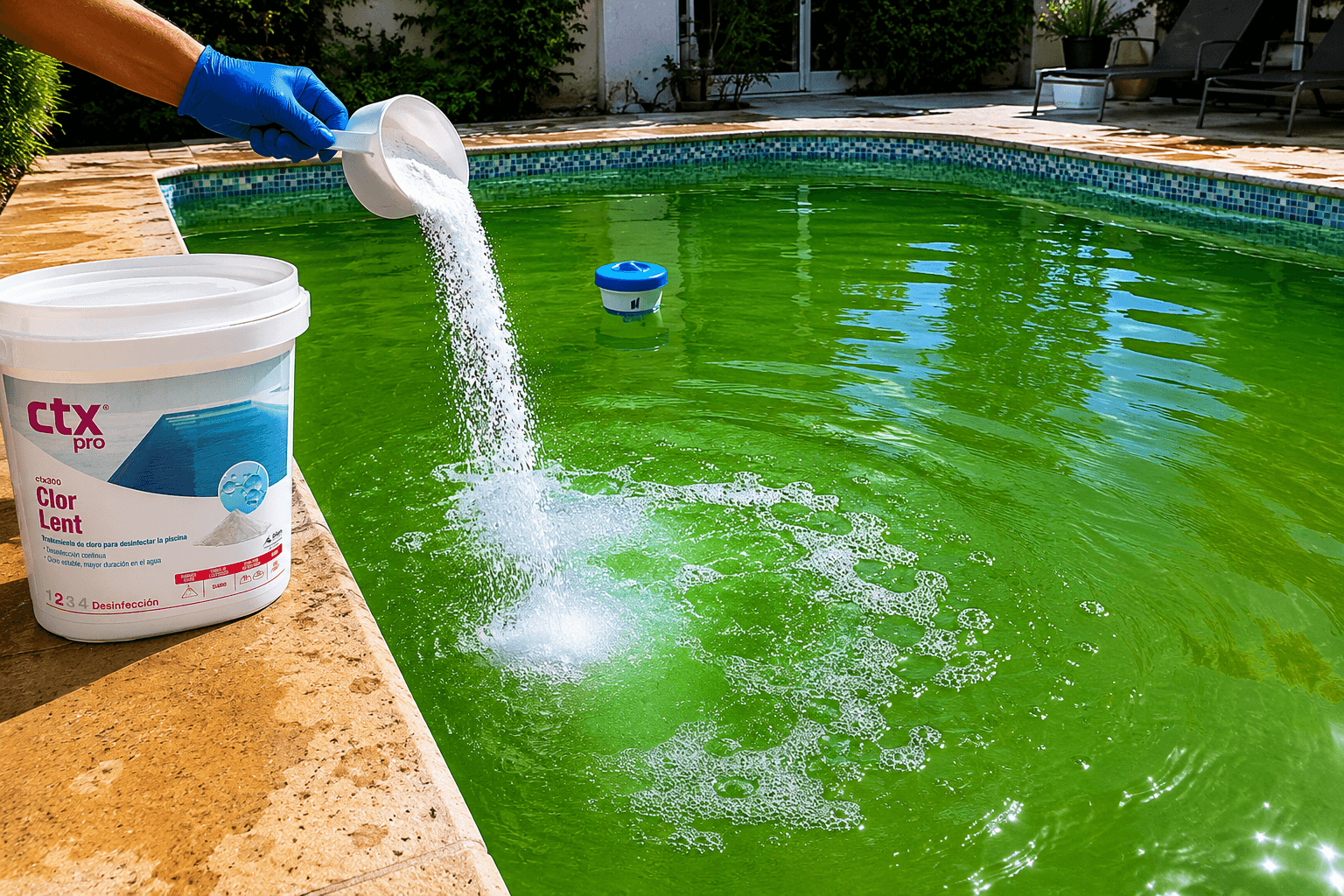
You open the tarp or arrive at your second home on a Friday afternoon, lift the cover and find the pool turned into green soup. Saturday you have guests. The question isn't why, it's how long do I need for the water to be crystal clear again.
The short answer: if the pool is only green (not brown, not black, not foul-smelling), 24-48 well-managed hours are enough. What follows is the exact protocol, with real doses calculated according to your pool's cubic meters, the mistakes most people make that stretch the problem out a week, and when you should give up and drain it.
Technical note: this protocol assumes your pool's filtration is working, there's no biofilm spread on the walls or pump failure, and the problem is green algae (the most common). If your water is brown, milky with a strong smell, or you see black spots on the walls, we need to write other articles for that.
Why has it turned green?
The green is chlorophyll. It means you have algae multiplying freely because, at some point, your pool's chlorine fell below the threshold that keeps them in check. Once algae establish themselves, the problem accelerates on its own: the algae themselves consume chlorine as they reproduce, the pH shifts, sunlight pushes photosynthesis and, in 48-72 hours of neglect, what was slightly cloudy water becomes completely green.
The real causes are always some combination of these four:
-
Insufficient chlorine. Chlorine tablet poorly dosed, empty dispenser, salt electrolysis with low production, days when you lower the rate "because nobody's swimming".
-
Sustained altered pH. Above 7.6 or below 7.0 chlorine drops fast. At pH 8.0, up to 70% of the chlorine stops working.
-
Accumulated organic matter. Leaves, pollen, sunscreen residue, sweat. It consumes chlorine and feeds the algae.
That the water is green isn't a mystery. That the water stays green after adding chlorine is a mystery to many people, and the answer is almost always in points 2 and 3 of that list.
What do we need to do?
Don't start treating before measuring. You need two pieces of data:
pH - 7.2-7.4. Above 7.6 shock chlorine loses effectiveness. You have to correct it first.
Chlorine - 1-3 ppm. It tells you how much residual chlorine you have and, by contrast, how much you need to reach shock level.
The best way to measure it is with a drop test kit. Take water at a depth of 30/40cm (dipping your arm deep), add 5 drops of the corresponding solution in each tube and look against the light to see what values it corresponds to.
What to do based on the results?
First we need to regulate the pH
-
If pH is above 7.6 or below 7.0: add pH reducer or increaser. Wait 2-3 hours and measure again before doing anything else.
-
If pH is within range go directly to the shock protocol.
Shock protocol: the 8 decisive hours
The scheme is always the same and follows this strict order:
-
Pool cleaning
-
pH correction if necessary
-
Shock chlorination
-
Continuous filtration
Skipping steps or changing the order prolongs the problem. Let's go through them one by one.
Step 1: cleaning (15-30 minutes)
Before touching the chemistry, remove with a leaf skimmer everything that floats and everything you see on the bottom. With a green pool you probably won't see the bottom, but run the leaf skimmer blindly through the corners where sediment accumulates (near the skimmers, in the deep corners).
Step 2: correct the pH if it's not in range
If your measurement showed pH above 7.6, add reducer. If it showed below 7.0 add a pH increaser. Read the product amounts according to your pool's cubic meters to add.
Step 3: shock chlorination (the most important)
Correct procedure:
-
Pour 2/3 handfuls of granular chlorine directly into the skimmer basket. If your pool doesn't have a basket, don't pour it dry directly (you risk some settling on the bottom and leaving bleached stains). Dissolve the chlorine in a bucket separately and then pour it into the pool.
-
Do the process with the pump running.
-
If possible do it when the sun is less intense (evening for example). UV radiation destroys free chlorine very quickly and reduces shock effectiveness by 50-70% if you do it at noon.
-
Once added, keep the pump running for 24 hours straight. Don't turn it off at night.
Step 4: continuous filtration for 24 hours
Chlorine kills the algae, but dead algae don't disappear on their own: they remain in suspension and are what gives the water that cloudy, milky or grayish appearance after shock. What removes them from your pool is the filter.
Set the pump to filter mode (not recirculation, not rinse), at maximum speed if your pump is variable speed, and leave it 24 hours minimum straight. If your pool is large (more than 60 m³) or very green, extend it to 36-48 hours.
During this period:
-
Do a filter backwash at 6-8 hours and another at 18-24 hours. The filter will saturate quickly with dead algae and, if you don't clean it, it stops retaining particles and the water won't clear.
-
Don't swim for at least 24 hours after treatment. Even if the pool already looks transparent, chlorine levels after shock are too high (up to 10-15 ppm) and can irritate skin and eyes.
Step 5: final rebalancing
With the pool now clear, measure all parameters again:
-
pH: adjust to 7.2-7.4.
-
Chlorine: it's probably still high. Wait for it to drop on its own (24 more hours).
From here, return to normal maintenance with constant chlorination. The most common post-shock mistake is relaxing for 3-4 days, not measuring anything, and realizing the following Friday that the water has turned turquoise-green again.
Frequently asked questions
Can I swim in a recently restored pool?
Ideally when free chlorine has dropped to 1-4 ppm. After a shock treatment it usually takes an additional 24-48 hours, depending on temperature and solar radiation.
Does chlorine tablets work for shock treatment?
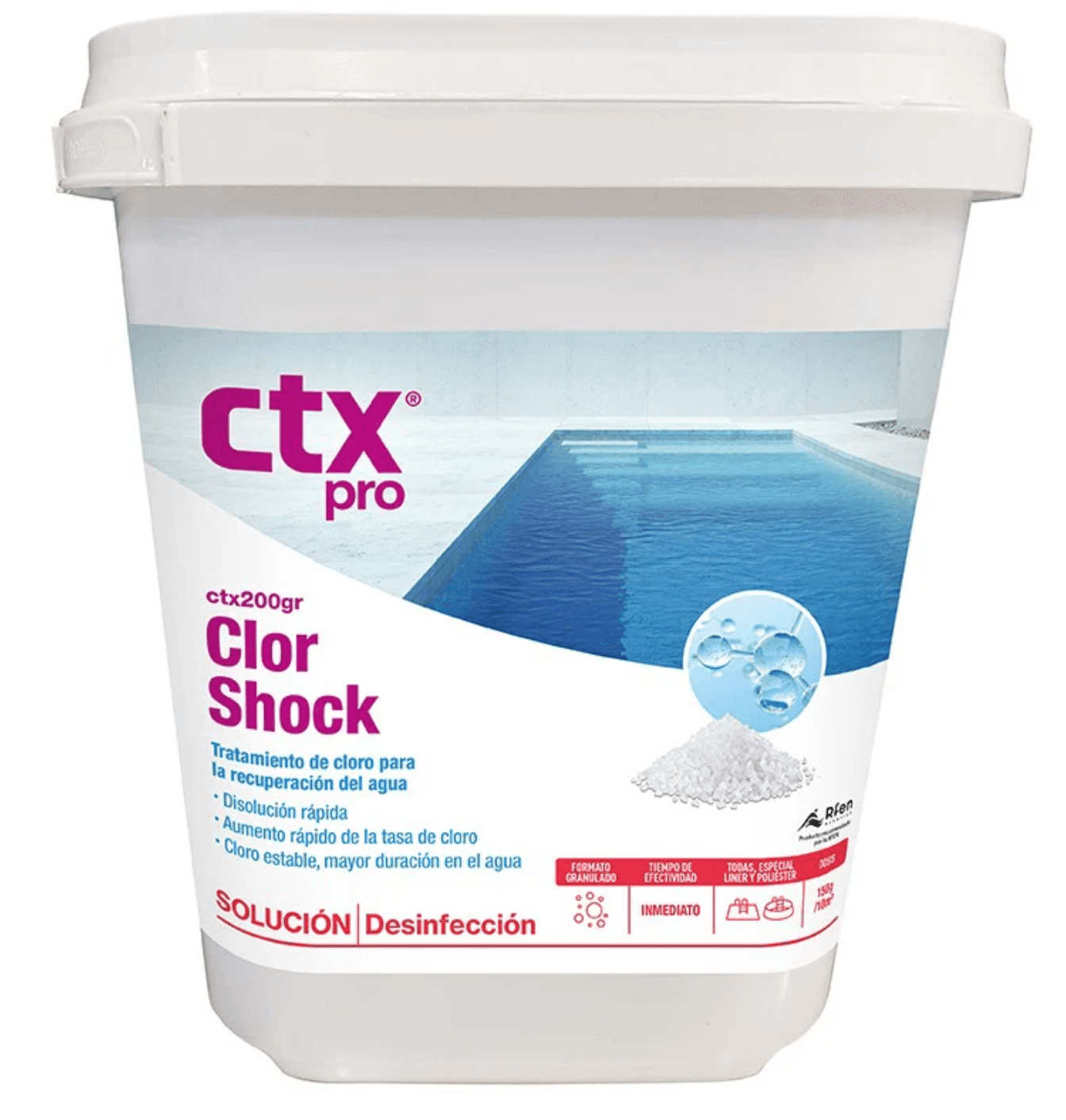
No. The tablets release chlorine slowly, designed for maintenance, not for shock treatment. Ideally you need fast-dissolving granulated chlorine.
Do algaecides replace shock chlorine?
They do not replace it. Algaecides prevent algae growth and help control it, but once algae has already appeared we need chlorine to kill organic matter and disinfect. Algaecide is useful for maintenance or as a booster, not as a primary treatment.
Comments
Log in to comment and like.
Login